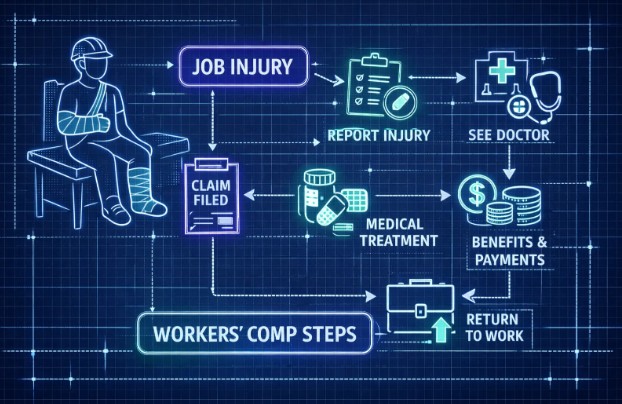
The workers’ comp process after a job injury in NC starts moving the moment you’re hurt, whether you’re ready or not. One day you’re on the job, the next you’re in pain, out of work, and staring at a sequence of forms and deadlines you’ve never had to navigate before.
The insurance carrier has professionals working on its side from the moment your supervisor files that first report. One missed form or late notice can kill a valid claim entirely.
North Carolina’s workers’ compensation system is a defined sequence of steps, deadlines, and forms governed by the NC Industrial Commission. It isn’t complicated once you understand the structure, but it has no tolerance for mistakes.
Attorney Perry Morrison of Morrison Law Firm, P.L.L.C., has been helping injured North Carolinians navigate this exact process since 1989. In that time, he’s seen what goes wrong and what goes right.
Here’s the complete roadmap: what to do after a job injury in NC, in the order you need to do it, with the deadlines that matter. The structure is straightforward. The consequences of ignoring it are not.
Unless you can show that your employer was already aware of the injury, N.C.G.S. § 97-22 sets the standard plainly: notify your employer immediately upon the occurrence of a workplace accident, or as soon as practicable. Thirty days is the absolute ceiling, not the target. [There is forgiveness only if you can prove reasonable cause for the delay satisfactory to the Industrial Commission.] This applies to sudden traumatic accidents and occupational disease diagnoses alike.
The NC Industrial Commission can excuse a late report in rare circumstances, but you cannot count on that exception to save your claim. For a plain-language guide on reporting timelines, see this article on how long you have to report a workplace injury.
A supervisor can forget a conversation. A supervisor can deny it ever happened. Written notice creates a paper trail that is very difficult to dispute.
Your notice should include the date of the incident, the location, exactly what happened, and the nature of your injury. Keep a copy for yourself. Send it by email or hand-deliver it and note the date.
Claims can be denied outright after 30 days. The insurance carrier will use a late report as evidence that the injury either didn’t happen at work or wasn’t serious enough to be reported promptly.
The window is short, the consequences are permanent, and the Industrial Commission grants exceptions narrowly. Report your injury in writing today, not next week.
You were hurt at work, and the 30-day window is running. Contact Morrison Law Firm now for a free consultation before a missed deadline costs you your claim.
If you’re ready to get started, call us now!
There is no waiting period for medical benefits. From the day of your injury, covered treatment includes hospitalization, surgery, prescriptions, physical therapy, diagnostic testing, and prosthetics.
The treatment must serve one of three purposes: to cure the injury, to facilitate a return to work, or to relieve pain. If it meets that standard, it’s covered.
North Carolina gives the employer’s insurance carrier the right to select your treating physician, at least initially. If you seek treatment outside that network without prior authorization, those medical bills can land in your own pocket.
Going outside the authorized network without approval is one of the most damaging mistakes injured workers make in the NC workers’ comp process, and one of the most avoidable. Chiropractic care beyond 20 visits also requires special authorization from the carrier.
If you disagree with the assigned physician, you can formally request a change through the NC Industrial Commission by filing a motion or petition with the Commission, but bypassing that process on your own is not an option. There are protocols involving such a motion that don’t appear in the statutes, but only an experienced attorney will know them.
Treatment continues until your doctor determines you’ve reached maximum medical improvement (MMI). After the last payment of any compensation, a two-year window opens during which you can still access treatment.
Filing Form 18M with the Industrial Commission keeps that window active and protects your right to future medical care related to the injury.
Notifying your employer is not the same as filing a claim. Those are two separate steps. Form 18 is the employee’s official Notice of Accident and Claim filed directly with the NC Industrial Commission.
It must be completed in full, signed, and mailed to the Commission’s Claims Administration office. The mailing address is:
Claims Administration NC Industrial Commission 4334 Mail Service Center Raleigh, NC 27699-4334
Send two signed copies to the Commission, one to your employer, and keep one for your records. An electronic version is available at ic.nc.gov for single-employer cases.
You have two years from the date of injury, or from the last payment of compensation, to file Form 18. Missing this deadline bars your claim entirely. It doesn’t matter how strong your case is, how clear the liability is, or how serious your injury was. There are almost no exceptions.
The NC Industrial Commission enforces this deadline rigidly, and courts uphold it. Set a reminder now. For a practical overview of common workers’ comp deadlines in North Carolina, see this resource.
Your employer must file a Form 19 with the Industrial Commission and provide you with a blank Form 18. Once the insurer receives notice, they have 14 days to respond in one of three ways: admit the claim with Form 60, deny it with Form 61, or reserve their decision with Form 63 for up to 90 days.
That initial response shapes everything that follows. An admission starts your benefits. A denial triggers a different set of steps.
Not sure if your Form 18 was filed correctly or on time? Talk to Perry Morrison before the two-year window closes.
If you’re ready to get started, call us now!
Medical treatment is covered from day one, but wage replacement doesn’t begin until after seven calendar days of lost work. Most workers don’t expect this, especially those counting on a check in that first week.
You will not receive payment for the first 7 days unless your disability extends beyond 21 days. The waiting period exists to filter out minor, short-duration claims.
If you’re out of work for more than 21 days, those first seven days are paid retroactively. If your disability lasts 21 days or fewer, days 1 through 7 are not compensated.
The wage replacement rate is two-thirds of your average weekly wages, subject to an annual state cap. That cap changes each July 1 based on the state’s average weekly wage figure.
The first wage benefit payment is due no later than 14 days after the employer learns of the injury. Medical bills submitted to the carrier are typically processed within two weeks, and carriers that pay late owe a 10% penalty on the delayed amount under NC Industrial Commission rules.
Keep records of every payment you receive and every bill you submit. Gaps and delays happen, and documentation is how you address them.
Once the claim is filed and the carrier is notified, the carrier has 14 days to admit, deny, or reserve rights. That response is the first real fork in the road. An admission under Form 60 triggers benefits and starts the clock on your payments.
A denial under Form 61 tells you exactly what grounds they’re using against you, which gives you something to work with if you decide to appeal.
Most workers’ comp claims don’t settle until MMI is reached, because that’s the point at which your permanent impairment can be properly assessed and valued. Reaching MMI can take months, sometimes a year or more, depending on the severity of the injury and the nature of treatment.
After MMI, settlement negotiations begin and can take additional months. Total time from injury to final settlement typically runs 9 to 18 months, sometimes longer. For more on typical timelines for NC claims, read this overview of how long a workers’ comp claim can take in North Carolina.
Denial, disputes over the cause of the injury, and hearings before the NC Industrial Commission each add months to the process. Mediation is generally required before a formal hearing can be scheduled, per NC Industrial Commission procedure.
After a settlement agreement is reached, Commission approval takes 2 to 8 weeks before a payout is issued.
There is no shortcut through a disputed claim. The only way to shorten the timeline is to have every step handled correctly from the start, with no missed deadlines and no missteps on documentation.
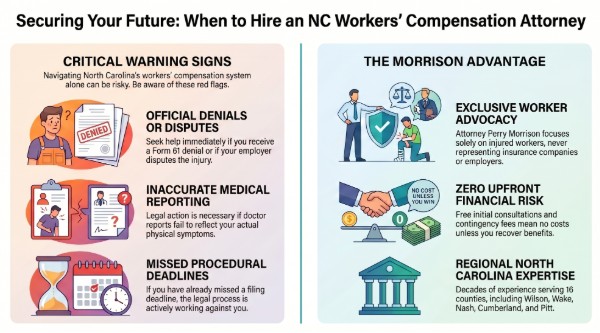
Some situations call for an attorney immediately. If your employer disputes whether the injury happened at work, if the insurer issues a Form 61 denial, if the assigned doctor’s reports don’t reflect your actual symptoms, or if you’ve already missed a deadline, the process is working against you. These aren’t situations to manage alone. The insurance carrier has legal counsel involved from day one. You deserve the same.
Attorney Perry Morrison of Morrison Law Firm, P.L.L.C., has represented injured workers through the NC Industrial Commission process for well beyond three decades, focusing exclusively on the injured worker’s side, never for insurance companies or employers.
He knows the forms, the filing deadlines, the hearing procedures, and the tactics insurance carriers use to delay or deny valid claims. Morrison Law Firm serves clients across 16 North Carolina counties, including Wilson, Wake, Nash, Cumberland, and Pitt. See the full list of areas we serve.
Morrison Law Firm, P.L.L.C., offers free initial consultations for injured workers. Workers’ comp attorneys typically work on contingency, meaning there are no upfront fees and no legal costs unless you recover benefits.
Getting legal advice early costs nothing and can prevent the kinds of costly mistakes that end otherwise solid claims. If you’re unsure whether your claim is on track, a single conversation can tell you where you stand.
The workers’ comp process after a job injury in NC carries real stakes at every step. Three numbers are worth memorizing right now: 30 days to report your injury to your employer, 2 years to file Form 18 with the NC Industrial Commission, and 7 days before wage replacement benefits begin.
Miss the first deadline, and your claim is in jeopardy. Miss the second, and it’s gone entirely.
Medical treatment is covered from day one. Wage replacement starts after the waiting period.
The insurer has 14 days to respond once the claim is filed. MMI drives the settlement timeline, and disputed claims add months. None of this is impossible to navigate, but none of it is forgiving either.
If you’ve been injured at work in North Carolina and you’re not sure your claim is properly protected, contact Morrison Law Firm, P.L.L.C. for a free consultation. Attorney Perry Morrison has been handling workers’ comp claims for over three decades. Call the firm, ask your questions, and find out exactly where you stand before a deadline makes the decision for you.
What is the first step after a job injury in North Carolina?
The first step after a job injury in North Carolina is notifying your employer in writing as soon as possible, and no later than 30 days from the injury date under N.C.G.S. § 97-22, to preserve your right to file a claim.
How do I officially file a workers’ comp claim in NC?
Injured workers in North Carolina file a workers’ comp claim by completing Form 18 and mailing it to the NC Industrial Commission’s Claims Administration office in Raleigh within two years of the injury date.
Does workers’ comp cover medical treatment immediately after an injury?
Workers’ comp in North Carolina covers medical treatment from the day of injury with no waiting period, including hospitalization, surgery, prescriptions, physical therapy, and diagnostic testing, as long as treatment meets covered purposes.
Can I choose my own doctor for a workers’ comp injury in NC?
North Carolina gives the employer’s insurance carrier the right to direct treatment and to select the treating physician. Injured workers who seek unauthorized outside treatment risk having those medical bills denied and must petition the NC Industrial Commission to change providers. This is a process fraught with complications.
When does wage replacement begin under NC workers’ comp?
Wage replacement under North Carolina workers’ comp begins after seven calendar days of lost work. If the disability extends beyond 21 days, those first seven days are paid retroactively at two-thirds of the worker’s average weekly wage.
How long does a workers’ comp claim take to settle in North Carolina?
Most workers’ comp claims in North Carolina settle between 9 and 18 months after the injury, with the timeline driven by when maximum medical improvement is reached and whether the insurer disputes liability or causation.
What happens if my workers’ comp claim is denied in NC?
A denied workers’ comp claim in North Carolina triggers a formal appeal process before a Deputy Commissioner at the NC Industrial Commission, which is initiated by filing Form 33 and requires mandatory mediation before any hearing is scheduled.
Do I need an attorney for a workers’ comp claim in North Carolina?
While it is possible to represent yourself, it is not advisable. You could make decisions that will affect the rest of your life, and there is no going back. Injured workers with denied claims, employer disputes, permanent impairment ratings, or settlement offers on the table benefit significantly from legal representation, since insurance carriers have legal counsel involved from the first day of the claim.

About the Author
B. Perry Morrison Jr. is a North Carolina attorney (Bar No. 16376) and founder of Morrison Law Firm, PLLC in Wilson, North Carolina. Since 1989, he has represented injured workers, Social Security Disability claimants, and personal injury victims throughout Eastern North Carolina, handling more than 3,000 workers' compensation claims before the North Carolina Industrial Commission. He concentrates his practice on workers' compensation, Social Security Disability, personal injury, and wrongful death cases, representing claimants exclusively rather than employers or insurance companies.
Mr. Morrison is admitted to practice before the North Carolina Supreme Court, all North Carolina state courts, the U.S. Fourth Circuit Court of Appeals, and the U.S. District Courts for the Eastern and Middle Districts of North Carolina. He has held leadership roles within the North Carolina Bar Association, including serving as Chair of the Litigation Section, and has earned the AV Preeminent® peer rating for legal ability and professional ethics. Through decades of advocacy, he has helped injured and disabled individuals navigate complex legal claims while protecting their rights and access to benefits.
Morrison Law Firm represents injured workers across Eastern North Carolina from its Wilson, NC, office. The firm accepts workers' compensation, Social Security Disability, and personal injury cases from Wilson, Nash, Edgecombe, Pitt, Martin, Wayne, Johnston, Greene, Halifax, Northampton, Warren, Wake, Harnett, Cumberland, Sampson, and Vance counties.
© 2026 Morrison Law Firm P.L.L.C
All Right Reserved
Practice Areas
Quick Links