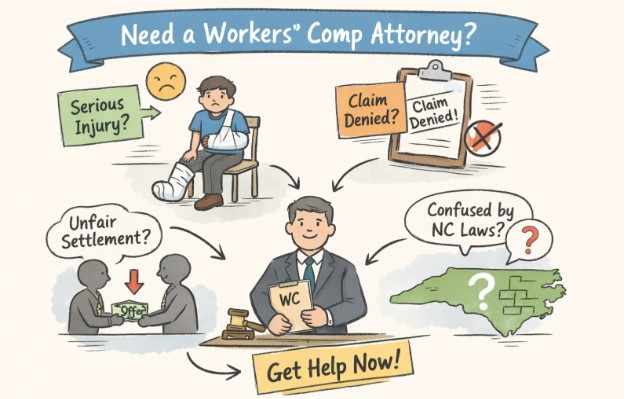
If you’re wondering when you should hire a workers’ comp attorney in North Carolina, the answer usually comes down to five specific situations, and most injured workers don’t recognize them until they’ve already lost ground.
Many assume they don’t need a lawyer unless something goes seriously wrong. That assumption is exactly what costs them. Waiting to see how things develop is rarely the neutral move it feels like in the moment.
After representing injured and disabled workers in North Carolina for over 35 years, Attorney Perry Morrison has seen a consistent pattern: the workers who end up shortchanged are typically the ones who held off too long.
They weren’t careless; they just didn’t recognize the signals early enough. Here are the five clearest signs that going it alone is no longer working in your favor.
A denial from the NC Industrial Commission or an insurer is not a final answer, but it opens a narrow window with hard deadlines. Common reasons insurers deny claims include:
Insurers count on workers not knowing what comes next.
If your claim has been denied, it’s important to understand the steps to appeal a denied claim so you can preserve your rights. Insurers have experienced legal teams on their side from day one. Showing up to that process without representation is precisely what they’re hoping for.
Your claim was denied, and the deadline is running out. Contact Morrison Law Firm for a free consultation before that window closes.
If you’re ready to get started, call us now!
Early warning signs of employer pressure after a workers’ comp filing often look subtle but follow a recognizable pattern. Watch for:
These are not coincidences. Retaliation patterns escalate if left unaddressed.
Retaliation for filing a workers’ comp claim is illegal under North Carolina’s Retaliatory Employment Discrimination Act (REDA), codified at N.C. Gen. Stat. § 95-241. Many workers don’t report it because they don’t realize it’s a protected right.
Miss the filing deadline, 180 days from the retaliatory action, with the Retaliatory Employment Discrimination Bureau, and that protection is gone.
When an employer disputes how or where the injury happened, the case becomes a credibility contest. Witness accounts, surveillance footage, incident reports, and employer records all become part of the evidentiary picture.
A workers’ compensation attorney knows how to preserve that evidence and present it effectively before a Deputy Commissioner. Going up against an employer-insurer legal team without representation is a structural disadvantage that compounds over time.
When a physician assigns a permanent partial disability (PPD) rating, that number controls your total compensation. Under N.C.G.S. § 97-31, the calculation uses three factors:
Example: a 25% impairment rating to an arm equals 60 weeks of compensation (25% of 240 statutory weeks). The difference between an accurate rating and an undervalued one is not small.
Physicians hired by insurers may have a financial incentive to produce conservative ratings, and workers often accept the assigned number without knowing they have the right to challenge it.
An NC workers’ comp attorney can request an independent medical examination (IME) to contest a lowball assessment. The math is straightforward: the gap between an accurate rating and a conservative one often exceeds any attorney fee when calculated over the full compensation period.
A permanent rating has been assigned to your injury. Talk to Perry Morrison before accepting any number that an insurer’s physician produces. Remember, the insurer’s physician is paid by the insurance company, and sometimes that produces predictable results.
If you’re ready to get started, call us now!
Insurers move quickly on settlements to close files before the full scope of losses becomes clear. Before signing any lump-sum compromise settlement agreement, understand what you are typically waiving:
A clincher agreement is binding once the NC Industrial Commission approves it and cannot be undone. Some people sign too soon with disastrous results several years later.
Disputed causation cases cover a wide range of injury types that require specific medical and legal evidence. Common categories include:
North Carolina law allows benefits when work aggravates a pre-existing condition, but proving that aggravation requires specific medical evidence and a legal framework that goes beyond completing standard claim forms.
Under N.C.G.S. § 97-22, you must notify your employer of a work-related injury within 30 days. That’s not a guideline; it’s a legal requirement, and failure to comply can bar your benefits entirely. There are rare exceptions, but the burden of proof of why you were late can be quite high, and the results are not predictable.
Beyond that, your Form 18 must be filed with the NC Industrial Commission within 2 years of the injury or occupational disease diagnosis. Missing that deadline permanently forfeits the claim. Completing this form without an attorneys advise on the description of the injury could lead to a quick denial that will not be changed even when your attorney explains to the adjuster that the company acted to quickly.
The moment you suspect a claim is being mishandled or disputed, the clock is already running. Waiting to see how things develop doesn’t pause those deadlines.
Workers’ comp attorneys in North Carolina work on a contingency basis: generally 25% of the compensation they recover, subject to approval by the NC Industrial Commission under N.C. Gen. Stat. § 97-90.
There are no upfront fees, no hourly billing, and no fee owed if no compensation is recovered. The attorney’s financial interest is directly tied to securing a fair outcome for you.
This fee structure exists so that injured workers aren’t priced out of representation when they need it most. Cost is not a reason to delay getting a free consultation with an experienced NC workers’ comp attorney.
Attorney Perry Morrison of Morrison Law Firm, P.L.L.C., offers free consultations to injured workers across North Carolina.
The consultation is a genuine assessment: an honest conversation about whether representation makes sense for your situation, what the claim may realistically be worth, and what steps protect it right now.
Perry Morrison has represented injured and disabled workers in North Carolina since 1989, exclusively on their side, never for an insurance company or an employer.
His practice covers 16 counties across eastern and central North Carolina, including Wilson, Nash, Wake, Cumberland, Pitt, and Edgecombe. See the full list of areas Morrison Law Firm serves.
That first conversation costs you nothing and gives you something concrete: a clear read on whether you need help and whether your case is worth pursuing.
Workers who regretted not hiring an attorney sooner didn’t do so because they were indifferent to their own cases. They waited because they weren’t certain they needed one. That uncertainty is exactly what a free consultation resolves.
When you’re asking when to hire a workers’ comp attorney in North Carolina, here’s the direct answer: the moment any of these five situations applies to your case, you’re past the point where going it alone serves your interests.
A denied claim, employer pressure, a permanent rating, a settlement offer, or a disputed cause of injury — each one means the other side already has a legal strategy in place.
If any of these situations match what you’re facing, a conversation with Perry Morrison costs you nothing.
Call Morrison Law Firm, P.L.L.C. at 252-243-1003 or contact us online for a free consultation and get a clear picture of where your case stands before you make any decisions you can’t take back.
What should I do immediately after a work injury in North Carolina?
After a work injury in North Carolina, report the incident to your employer in writing the same day, seek treatment from an authorized physician, and call Morrison Law Firm, P.L.L.C. at (252) 243-1003 for a free consultation before signing anything an insurance carrier presents.
How much does workers’ compensation pay in North Carolina?
North Carolina workers’ compensation pays two-thirds of your average weekly wage from the 52 weeks before your injury. The North Carolina Industrial Commission sets the maximum weekly benefit at $1,446 for 2026 injuries. Payments are entirely tax-free, so most injured workers find that the benefit closely approximates their actual take-home pay.
Does workers’ compensation cover a work injury that was my fault in North Carolina?
Workers’ compensation in North Carolina covers a job injury even when the employee caused the accident. The compensability standard under Chapter 97 of the N.C. General Statutes requires only that the worker was acting within the course and scope of employment when the injury occurred.
Can workers’ compensation cover a work-related illness or occupational disease in North Carolina?
Workers’ compensation covers occupational diseases and work-related illnesses listed as scheduled conditions under Chapter 97 of the N.C. General Statutes. Attorney Perry Morrison has personally handled more than 100 occupational disease claims in North Carolina, including cases involving workplace hearing loss from prolonged noise exposure.
Can I collect both workers’ compensation and Social Security Disability benefits at the same time?
Yes — North Carolina workers’ compensation recipients may simultaneously apply for and receive Social Security Disability benefits. However, the Social Security Administration applies an offset rule that reduces SSDI payments when combined benefits exceed 80 percent of the claimant’s average pre-disability monthly earnings.
What is the difference between Social Security Disability Insurance and Supplemental Security Income?
Social Security Disability Insurance is a Title II benefit funded by an applicant’s own payroll tax contributions while working. SSI is a Title XVI benefit drawn from federal revenues and reserved for disabled people who meet the Social Security Administration’s income and asset poverty thresholds, regardless of work history.
Why does Social Security keep denying my disability claim?
Social Security denied approximately 62 percent of all initial disability applications in fiscal year 2024, typically because the agency determined the applicant retains some capacity for substantial gainful activity. High SSA caseload backlogs drive that rate, making representation by an experienced Wilson disability attorney essential from the first denial.
Should I appeal after Social Security denies my initial disability application?
Yes — most initial Social Security disability applications are denied regardless of condition severity, and appealing is nearly always the right path. Claimants must file a Reconsideration request within 60 days of the denial letter. An experienced Wilson disability attorney strengthens the case at reconsideration and every stage that follows.
How long does a Social Security disability appeal take in North Carolina?
As of 2025, the entire process usually takes 26 months from the filing to a favorable decision at an ALJ hearing. Appeals in North Carolina take 3 to 9 months at the Reconsideration stage and an average of 9 months to reach an Administrative Law Judge hearing. Claimants who reach multiple appeal levels should expect the total process to span of about three years.
How much does it cost to hire a disability or workers’ compensation attorney at Morrison Law Firm?
Hiring attorney Perry Morrison for a Social Security disability or workers’ compensation claim costs nothing unless you win. Social Security disability attorney fees are capped by federal law at 25 percent of past-due benefits, plus there is a further limiting cap that is tied to the SSD recipients COLA. Workers’ compensation fees are similarly regulated and approved by the North Carolina Industrial Commission before payment, and they are generally set at 25 percent.

About the Author
B. Perry Morrison Jr. is a North Carolina attorney (Bar No. 16376) and founder of Morrison Law Firm, PLLC in Wilson, North Carolina. Since 1989, he has represented injured workers, Social Security Disability claimants, and personal injury victims throughout Eastern North Carolina, handling more than 3,000 workers' compensation claims before the North Carolina Industrial Commission. He concentrates his practice on workers' compensation, Social Security Disability, personal injury, and wrongful death cases, representing claimants exclusively rather than employers or insurance companies.
Mr. Morrison is admitted to practice before the North Carolina Supreme Court, all North Carolina state courts, the U.S. Fourth Circuit Court of Appeals, and the U.S. District Courts for the Eastern and Middle Districts of North Carolina. He has held leadership roles within the North Carolina Bar Association, including serving as Chair of the Litigation Section, and has earned the AV Preeminent® peer rating for legal ability and professional ethics. Through decades of advocacy, he has helped injured and disabled individuals navigate complex legal claims while protecting their rights and access to benefits.
Morrison Law Firm represents injured workers across Eastern North Carolina from its Wilson, NC, office. The firm accepts workers' compensation, Social Security Disability, and personal injury cases from Wilson, Nash, Edgecombe, Pitt, Martin, Wayne, Johnston, Greene, Halifax, Northampton, Warren, Wake, Harnett, Cumberland, Sampson, and Vance counties.
© 2026 Morrison Law Firm P.L.L.C
All Right Reserved
Practice Areas
Quick Links