Privacy note: “Valerie” is not the client’s real name. Identifying details — including employer name, product type, and workplace location — have been modified to protect client confidentiality.
B. Perry Morrison, Jr., attorney at the Morrison Law Firm in Wilson, North Carolina, represented Valerie (name changed for privacy) — a 61-year-old tech distribution warehouse employee — through two on-the-job fall injuries and employer retaliation.
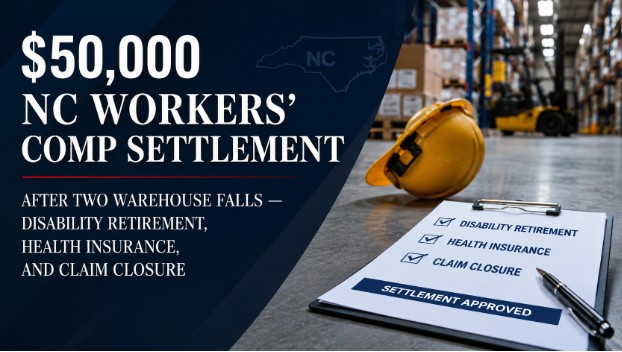
Morrison secured a $50,000 combined settlement, disability retirement with monthly income for life, and continuation of health insurance until Medicare eligibility at age 65.
A co-worker left a forklift parked in an unauthorized location in January 2024, obscured behind stacked pallets, with forks protruding onto the floor in a dimly lit area.
Valerie, carrying tech products with both hands, tripped over the exposed forks and fell hard onto the concrete floor. OSHA’s powered industrial truck standard under 29 CFR 1910.178 requires employers to maintain clear travel paths and enforce proper forklift parking procedures.
The treating physician placed Valerie on work restrictions limiting her ability to lift and reach. Valerie returned to restricted duty — but the workplace she came back to had changed.
Months later, while climbing down a ladder taking inventory, Valerie’s left foot slipped off the third step. Valerie fell onto the concrete again. An ambulance transported Valerie to the ER with injuries to her head, neck, both arms, left hip, and left eye — injuries far more severe than the first fall. The CDC’s National Institute for Occupational Safety and Health identifies falls as one of the leading causes of nonfatal occupational injuries across distribution and logistics industries.
Managers who had helped Valerie complete injury paperwork went cold the moment work restrictions took effect. Valerie was excluded from team meetings, relocated from her private office to a cubicle — “just for a little while,” management said — and noticed supervisors appeared to discuss her case amongst themselves without including her.
North Carolina’s Retaliatory Employment Discrimination Act prohibits employers from retaliating against employees who file workers’ compensation claims.
Retaliation includes discharge, suspension, demotion, retaliatory relocation, or other adverse employment action affecting terms, conditions, privileges, or benefits, so Valerie’s experience fell squarely within the conduct the statute targets. Valerie’s brother recognized the pattern and encouraged her to contact attorney Morrison.
If you’re ready to get started, call us now!
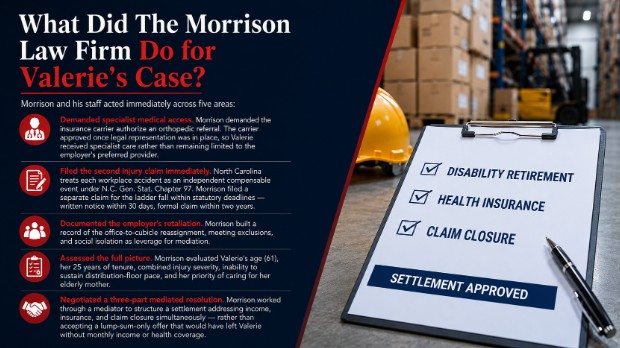
Morrison and his staff acted immediately across five areas:
If you’re ready to get started, call us now!
Morrison’s mediated resolution delivered three components:
Valerie’s focus had changed. After two serious falls and an employer who turned hostile, Valerie wanted to care for her elderly mother full-time. Morrison’s negotiated resolution gave Valerie income, insurance, and closure to do exactly that. Valerie’s mother now sees her every day.
Can a North Carolina worker file two separate workers’ comp claims against the same employer?
North Carolina law treats each workplace accident as an independent compensable event under N.C. Gen. Stat. Chapter 97. Valerie filed two distinct claims — one for the January 2024 forklift trip-and-fall and one for the ladder fall — each with separate medical documentation and settlement negotiations.
What qualifies as employer retaliation after a workers’ comp claim in North Carolina?
North Carolina’s Retaliatory Employment Discrimination Act prohibits employers from retaliating against employees who file workers’ compensation claims. Retaliation discharge, suspension, demotion, retaliatory relocation, or other adverse employment action affecting terms, conditions, privileges, or benefits. Valerie’s employer relocated her to a cubicle and excluded her from meetings after restrictions took effect.
How long does an injured worker have to file a workers’ comp claim in North Carolina?
North Carolina requires written notice to the employer within 30 days (unless there is a reasonable excuse for the delay) and a formal claim filed with the Industrial Commission within two years. Attorney Morrison filed Valerie’s second claim immediately after the ladder fall to preserve her full statutory rights.
Can a workers’ comp settlement include disability retirement in North Carolina?
Sometimes it can, depending on the circumstances and how much sway the employer has with the LTD carrier. Morrison negotiated Valerie’s settlement through mediation to include disability retirement with monthly income for life, health insurance until Medicare enrollment at 65, and a $50,000 lump-sum payment to close both claims. Twenty-five years of tenure and documented work restrictions supported the disability retirement component.
Does OSHA require employers to keep warehouse walkways clear of forklift hazards?
OSHA’s powered industrial truck standard under 29 CFR 1910.178 requires employers to maintain unobstructed travel paths and enforce proper forklift parking. Valerie’s employer allowed a co-worker to leave a forklift with protruding forks in an unauthorized, dimly lit warehouse area.
Can an injured worker in North Carolina choose their own doctor for a workers’ comp case?
North Carolina law generally allows the employer or insurance carrier to direct initial medical treatment. Because the employer’s immediate care doctor had already made the written referral to the orthopedic and it was still unauthorized, Attorney Morrison demanded that the carrier authorize an orthopedic specialist referral after Valerie’s first injury. The carrier approved the referral once Attorney Morrison made the demand and threatened a medical motion.
What happens when a workers’ comp injury prevents an employee from keeping up at work?
An injured worker whose restrictions prevent sustained job performance may qualify for disability retirement, a lump-sum settlement, or both. Valerie’s combined injuries left her unable to maintain a distribution warehouse pace, so Morrison structured a mediated exit with income, insurance, and claim closure.
How much was the workers’ comp settlement in Valerie’s North Carolina case?
Morrison negotiated a combined $50,000 tax-free lump-sum settlement closing both workers’ compensation claims. The resolution also included disability retirement, providing monthly income for life and employer-sponsored health insurance until Valerie reached Medicare eligibility at age 65.
What role does mediation play in settling a North Carolina workers’ comp case?
Mediation allows both parties to negotiate outside a formal Industrial Commission hearing. Many times this can be helpful, as elements outside of the Workers Compensation Act can be brought to the table. Morrison used mediation to structure Valerie’s three-part resolution — disability retirement income, continuation of health insurance, and a $50,000 lump sum — without the delay of a contested hearing.
Should an injured worker hire a workers’ comp attorney before or after employer retaliation?
Injured workers should consult an attorney as soon as possible after a workplace injury — before retaliatory patterns become entrenched. Valerie contacted Morrison after her brother’s recommendation, and early intervention secured an orthopedic referral and documented the employer’s retaliatory conduct.

About the Author
B. Perry Morrison Jr. is a North Carolina attorney (Bar No. 16376) and founder of Morrison Law Firm, PLLC in Wilson, North Carolina. Since 1989, he has represented injured workers, Social Security Disability claimants, and personal injury victims throughout Eastern North Carolina, handling more than 3,000 workers' compensation claims before the North Carolina Industrial Commission. He concentrates his practice on workers' compensation, Social Security Disability, personal injury, and wrongful death cases, representing claimants exclusively rather than employers or insurance companies.
Mr. Morrison is admitted to practice before the North Carolina Supreme Court, all North Carolina state courts, the U.S. Fourth Circuit Court of Appeals, and the U.S. District Courts for the Eastern and Middle Districts of North Carolina. He has held leadership roles within the North Carolina Bar Association, including serving as Chair of the Litigation Section, and has earned the AV Preeminent® peer rating for legal ability and professional ethics. Through decades of advocacy, he has helped injured and disabled individuals navigate complex legal claims while protecting their rights and access to benefits.
Morrison Law Firm represents injured workers across Eastern North Carolina from its Wilson, NC, office. The firm accepts workers' compensation, Social Security Disability, and personal injury cases from Wilson, Nash, Edgecombe, Pitt, Martin, Wayne, Johnston, Greene, Halifax, Northampton, Warren, Wake, Harnett, Cumberland, Sampson, and Vance counties.
© 2026 Morrison Law Firm P.L.L.C
All Right Reserved
Practice Areas
Quick Links