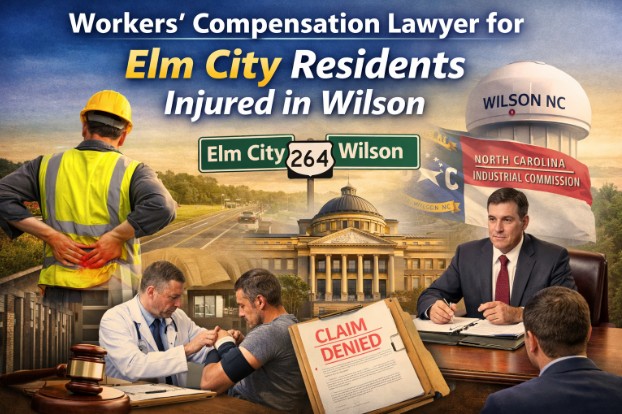
Elm City residents injured while working in Wilson face immediate decisions that determine authorized medical treatment and wage-loss benefits under North Carolina Workers’ Compensation.
Morrison Law Firm in Wilson represents injured workers from the first injury report through North Carolina Industrial Commission disputes.
The Wilson office sits about 8 minutes from downtown Elm City. Call to review next steps.
Many Elm City commuters reach Wilson job sites via the US-264 corridor, which often results in the injury report being submitted to a Wilson supervisor. At the same time, recovery documentation begins in Elm City.
The Wilson job location and Elm City home address frequently create paperwork gaps because medical restrictions, missed-time records, and job-duty descriptions are documented by different parties at different times.
North Carolina Workers’ Compensation covers a Wilson workplace injury even when the worker lives in Elm City, and the firm’s Workers’ Compensation representation explains how medical care and wage benefits move through the claim process.
Many Elm City residents work in Wilson manufacturing operations and medical facilities, and these sectors exhibit recurring injury patterns linked to lifting demands, repetitive motion, equipment exposure, and shift-based productivity pressure.
Workers often ask about reporting windows, benefits, and next steps, and Morrison Law Firm consolidates these answers on the FAQ page.
If you’re ready to get started, call us now!
A Workers’ Compensation dispute begins when an employer or insurance carrier contests a workplace injury, disputes eligibility for benefits, or limits medical care and wage-loss payments.
A claim often becomes disputed after a denial of compensability, a delay in authorized treatment, or a conflict between written work restrictions and the employer’s light-duty assignment.
North Carolina Industrial Commission litigation runs on procedure and evidence, so medical records, job-duty documentation, and restriction compliance determine leverage more than opinions or phone calls.
A commuter case can move into the hearing and dispute process when the carrier challenges the record.
| Carrier Focus | What We Lock Down Early |
| Injury timeline | Written timeline, witness identification, consistent reporting across employer and medical notes |
| Work duties | Duty description tied to the injury mechanism and job-task demands |
| Restrictions | Restriction compliance record, wage-loss documentation, and missed-time proof |
| Treatment | Authorization requests, referral tracking, and continuity of care documentation |
| Disputes | Hearing-ready file with medical evidence and work documentation aligned to the contested issue |
North Carolina Workers’ Compensation operates as a statutory benefits system with deadlines and Industrial Commission procedures, not as a typical fault-based injury case.
Local oversight reduces case drift by ensuring documentation quality is maintained early. Practical, evidence-first preparation improves outcomes when the insurer disputes treatment, restrictions, or wage loss.
North Carolina Workers’ Compensation operates as a statutory benefits system with deadlines, forms, and Industrial Commission procedure rather than a typical fault-based injury claim.
Local oversight prevents case drift because the attorney can control documentation quality, restriction compliance, and dispute posture before the file hardens into denial language.
A local Wilson practice improves outcomes through practical advantages:
Long-term Workers’ Compensation practice experience improves documentation discipline and dispute readiness from day one.
That discipline protects authorized treatment, supports wage-loss eligibility, and increases settlement leverage when a carrier contests compensability or restrictions.
Perry Morrison has represented injured North Carolinians since 1989, and long-term Workers’ Compensation practice experience improves documentation discipline and dispute readiness at every stage.
Perry Morrison’s civic leadership includes service as a Trustee of Wilson Community College and participation in North Carolina public service roles, which reinforce credibility in a high-stakes benefits process.
Experience strengthens outcomes because disciplined evidence-building supports authorized treatment, protects wage-loss eligibility, and creates settlement leverage when a carrier contests restrictions or compensability.
If you’re ready to get started, call us now!
Proximity reduces friction in a benefits case that depends on documents, work notes, and restriction updates. Elm City residents can reach the Wilson office quickly when a claim requires correction to medical authorization, wage documentation, or dispute preparation.
Elm City residents typically reach Morrison Law Firm in Wilson in about 8 minutes from downtown Elm City by driving on Lake Wilson Road, enabling injured workers to act quickly when documentation, medical authorizations, or wage benefits require immediate correction under North Carolina Workers’ Compensation.
Morrison Law Firm operates at 3713 Nash St N, Suite 101, Wilson, NC 27896, and appointment scheduling begins when injured workers contact our Wilson office.
Visitor parking is available near the office entrance, which supports direct access for consultations, document delivery, and claim reviews.
Early actions shape the claim record that later controls treatment authorization and wage-loss benefits. Elm City commuters improve outcomes by reporting clearly, aligning medical documentation with job duties, and preventing avoidable inconsistencies that trigger denials or Industrial Commission disputes.
Can I file workers’ comp if I live in Elm City but work in Wilson?
Yes. North Carolina Workers’ Compensation eligibility depends on the employment and the workplace injury, not the worker’s home address. An Elm City resident injured on a Wilson job site can pursue authorized medical treatment and wage-loss benefits through the same state claims process.
Does the commute route or where I live change my benefits?
No. A commute route and hometown do not reduce medical benefits or wage-loss benefits under North Carolina Workers’ Compensation. The commute can complicate the claim only when injury reporting, medical notes, and missed-time records are documented in different places and at different times.
What benefits does NC workers’ comp cover for Wilson workplace injuries?
North Carolina Workers’ Compensation can cover authorized medical care and wage-loss payments when work restrictions prevent full earnings. Benefit strength depends on timely reporting, consistent medical documentation, and clear proof of missed time and work capacity.
How long do I have to report a workplace injury in North Carolina?
North Carolina Workers’ Compensation requires a timely notice to the employer, and delay can weaken the claim record. Early written reporting improves benefit protection because statutory deadlines apply, and late notice often triggers disputes about timing, causation, and restrictions.
What happens if the insurance company denies my claim?
A denial turns the case into a procedure-driven dispute where medical evidence, job-duty documentation, and restriction compliance determine outcomes. A denial also triggers time-sensitive steps to challenge the carrier’s position through the North Carolina Industrial Commission.
What is a workers’ comp hearing with the NC Industrial Commission?
A Workers’ Compensation hearing is a formal dispute process in which the North Carolina Industrial Commission evaluates evidence regarding compensability, treatment, restrictions, and wage loss. The hearing record usually relies on medical notes, work records, and consistent incident reporting.
What does “authorized treating physician” mean in NC workers’ comp?
An authorized treating physician is the medical provider approved within the North Carolina Workers’ Compensation system to direct treatment. The authorized provider controls work notes, restrictions, referrals, and documentation that often determine whether benefits continue.
What if the carrier delays treatment or refuses a referral?
A treatment delay or refusal to refer can become a dispute issue that affects recovery and continuity of benefits. Written documentation of the request, the carrier response, and the medical impact strengthens the record if the issue escalates to the Industrial Commission.
Can I be fired for filing a workers’ comp claim in North Carolina?
North Carolina law provides protections against retaliation, but workers must carefully document events. Written records of work performance, restrictions, schedule changes, and adverse actions help evaluate whether the employer’s response relates to the claim.
Should I sign a settlement agreement without a lawyer?
No. A Workers’ Compensation settlement can permanently close parts of a claim, including future medical coverage and wage-loss exposure. A worker should evaluate the medical prognosis, the duration of the restriction, and the dispute posture before signing any release.
Elm City residents injured while working in Wilson improve claim outcomes when documentation, restrictions, and dispute preparation are handled correctly through the North Carolina Industrial Commission, and consultation begins when injured workers contact the Morrison Law Firm intake team.

About the Author
B. Perry Morrison Jr. is a North Carolina attorney (Bar No. 16376) and founder of Morrison Law Firm, PLLC in Wilson, North Carolina. Since 1989, he has represented injured workers, Social Security Disability claimants, and personal injury victims throughout Eastern North Carolina, handling more than 3,000 workers' compensation claims before the North Carolina Industrial Commission. He concentrates his practice on workers' compensation, Social Security Disability, personal injury, and wrongful death cases, representing claimants exclusively rather than employers or insurance companies.
Mr. Morrison is admitted to practice before the North Carolina Supreme Court, all North Carolina state courts, the U.S. Fourth Circuit Court of Appeals, and the U.S. District Courts for the Eastern and Middle Districts of North Carolina. He has held leadership roles within the North Carolina Bar Association, including serving as Chair of the Litigation Section, and has earned the AV Preeminent® peer rating for legal ability and professional ethics. Through decades of advocacy, he has helped injured and disabled individuals navigate complex legal claims while protecting their rights and access to benefits.
Morrison Law Firm represents injured workers across Eastern North Carolina from its Wilson, NC, office. The firm accepts workers' compensation, Social Security Disability, and personal injury cases from Wilson, Nash, Edgecombe, Pitt, Martin, Wayne, Johnston, Greene, Halifax, Northampton, Warren, Wake, Harnett, Cumberland, Sampson, and Vance counties.
© 2026 Morrison Law Firm P.L.L.C
All Right Reserved
Practice Areas
Quick Links