The exact wording of your clincher settlement — not just whether it mentions proration — determines how much of your SSDI check is subject to the federal offset.
Under Social Security’s lump-sum proration rules, SSA applies one of three formulas — Methods A, B, or C — to spread your settlement across time, and each produces a different dollar result.

Getting this wrong costs real money; getting it right, before you sign, is the only time SSA will honor it, so you can keep the SSDI income you’re owed.
A clincher agreement missing the right proration language can quietly shrink your SSDI check for years. Ask our Wilson team to review yours first.
Before Social Security counts your clincher settlement against the SSDI offset, it converts the lump sum into a weekly rate — the same way it would treat ongoing weekly comp payments.
That conversion is called proration, and it happens in a specific sequence: SSA determines the gross settlement amount, sets a proration start date, establishes a weekly proration rate, and then subtracts any excludable expenses before applying the offset.
Workers who are still early in the claims process often don’t realize that proration decisions made at settlement will affect their SSDI benefits for years — sometimes decades — after the comp case closes.
SSA doesn’t guess at a rate. It follows a strict order of priority: the rate stated in the clincher agreement itself comes first.
If none is specified, the agency falls back to your last periodic payment rate, then any rate implied by the settlement language, and finally North Carolina’s maximum comp rate on your injury date if nothing else applies.
If your prior weekly comp payments were running before the settlement, proration begins the day after those payments stopped — not the date you signed the clincher. If you never received periodic payments, SSA allocates the lump sum back to the date of injury.
Workers unfamiliar with filing deadlines sometimes confuse the settlement date with the proration start date, which can entirely change the offset calculation.
If you’re ready to get started, call us now!
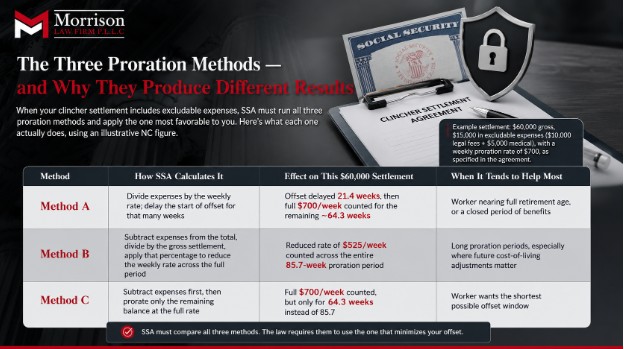
When your clincher settlement includes excludable expenses, SSA must run all three proration methods and apply the one most favorable to you. Here’s what each one actually does, using an illustrative NC figure.
Example settlement: $60,000 gross, $15,000 in excludable expenses ($10,000 legal fees + $5,000 medical), with a weekly proration rate of $700, as specified in the agreement.
| Method | How SSA Calculates It | Effect on This $60,000 Settlement | When It Tends to Help Most |
| Method A | Divide expenses by the weekly rate; delay the start of the offset for that many weeks | Offset delayed 21.4 weeks, then full $700/week counted for the remaining ~64.3 weeks | Worker nearing full retirement age, or a closed period of benefits |
| Method B | Subtract expenses from the total, divide by the gross settlement, and apply that percentage to reduce the weekly rate across the full period | Reduced rate of $525/week counted across the entire 85.7-week proration period | Long proration periods, especially where future cost-of-living adjustments matter |
| Method C | Subtract expenses first, then prorate only the remaining balance at the full rate | Full $700/week counted, but only for 64.3 weeks instead of 85.7 | The worker wants the shortest possible offset window |
Note the tradeoff: Method A and Method C both shrink the effective offset window to roughly the same length, but they do it from opposite ends — Method A delays the start; Method C moves up the end.
The most favorable method between Method A and Method C depends on the claimant’s age, other income, and how close they are to full retirement age, which is why POMS DI 52150.060 requires all three to be run before SSA picks one, not just the first one that applies.
Workers weighing whether to accept a settlement offer need to understand that the method SSA uses can change the net dollar outcome by thousands of dollars — even when the gross clincher amount stays the same.
If your clincher specifies a proration rate based on life expectancy rather than a flat weekly figure, SSA checks whether excludable expenses were already baked into that rate. If they were, the agency strips them back out and recalculates — using Social Security’s own actuarial life tables — before comparing all three methods again.
A life-expectancy period that looks unreasonable on its face (extending, for example, past age 100) gets flagged for special review rather than accepted automatically.
Once your clincher is signed, SSA will not accept new proration language to fix a mistake. Get the wording right before you sign.
If you’re ready to get started, call us now!
Not every dollar labeled “expense” in a clincher settlement reduces what SSA prorates. Social Security draws specific lines under POMS DI 52150.050: legal fees, medical costs, and properly structured Medicare set-asides paid by the worker can be excluded from the amount prorated, while fees paid by the employer or carrier, tax and support garnishments, and household task assistance cannot.
The distinction below determines how much of the settlement counts against the SSDI offset.
The MSA single-check-versus-two-check distinction trips up more settlements than almost anything else in this list: identical dollar amounts, structured as one check versus two, produce entirely different offset outcomes, so you can protect the exclusion simply by how the settlement check is written.
A clincher that bundles the MSA into a single payment protects the exclusion; splitting it into a second check erases it.
Workers receiving permanent disability benefits face especially high stakes on this point, because the longer the expected benefit period, the more each excluded dollar compounds over time.
SSA treats proration language added after a settlement is already signed as an attempt to manufacture a lower offset after the fact — not as a legitimate clarification — and rejects it outright.
Settlement timing is the single most consequential rule in this entire process: the protection has to be built into the clincher at signing, reviewed against the full offset framework before approval, not requested afterward once a claimant notices their SSDI check is lower than expected — so you can protect that benefit while there’s still time to fix the language.
In North Carolina, clinchers involving Eastern NC claimants are reviewed and approved by the NC Industrial Commission before they become final, under the Commission’s own settlement approval standards — separate from, and in addition to, how SSA will later treat the same language for offset purposes.
A form settlement and a clincher are approved through the same approval process but produce very different proration outcomes, which is part of why the choice between them matters as much as the dollar figure itself.
The cost of not having an SSD attorney involved at the clincher stage is measurable in lost SSDI income — not in theory, but in how SSA actually processes the offset after approval.
Claimants who recognize the signs that they need legal help before signing — rather than after — are the ones whose proration language holds up under SSA review and whose benefit amounts remain intact after the offset.
The formula behind your SSDI offset determines thousands of dollars over the life of your claim. Call Morrison Law Firm at 252-243-1003 today.
What are the three methods SSA uses to prorate a lump sum with excludable expenses?
SSA considers three separate methods when a settlement includes excludable expenses: Method A delays the offset until the excludable expenses are used up; Method B spreads the expenses evenly across the entire settlement period, lowering the weekly rate; Method C subtracts the expenses first, shortening the offset period.
How does the proration start date get determined for a lump-sum settlement?
If the settlement specifies a start date, SSA uses it. If not, and the worker received prior weekly payments, proration begins the day after those payments ended. Without any prior payments, SSA allocates the lump sum back to the date of injury.
What expenses can be excluded from a clincher settlement before SSA prorates it?
SSA excludes documented legal fees the worker paid, medical expenses connected to the claim, Medicare set-aside arrangements paid from the same check, and related costs like deposition fees or expert witness charges — but not garnishments for unpaid taxes or child support obligations.
Does a Medicare set-aside arrangement in a settlement count as an excludable expense?
Yes, but only if the workers’ comp payer issues the Medicare set-aside amount as part of the same lump-sum check. If the MSA is paid through a separate check, SSA disregards it and prorates only the remaining settlement amount going forward.
What is the priority order SSA uses to set the weekly proration rate?
SSA first uses the rate stated in the award itself. If none is specified, it uses the worker’s last periodic payment rate, then any implied rate in the settlement language, and finally the state’s maximum workers’ comp rate on the injury date.
Why does SSA reject proration language added after a clincher agreement is already signed?
SSA treats after-the-fact proration language as an attempt to manufacture a lower offset rather than a genuine settlement term. The original signed clincher agreement must state the proration method and rate that SSA will use to honor them during the offset calculation.
How is a life-expectancy proration rate verified under SSA rules?
If a settlement specifies a rate based on life expectancy, SSA checks whether excludable expenses were already subtracted to derive that rate. If they were, SSA would recalculate the rate without those expenses and then compare all three proration methods to find the most advantageous one.
Can attorney fees always be excluded from a workers’ comp settlement before proration?
Only if the worker, not the employer or insurance carrier, paid or incurred the legal fees in connection with the claim. Fees paid by the employer or carrier are not excludable, and SSA requires documentation before allowing the deduction from the settlement.
Where are NC Industrial Commission clincher agreements approved for Wilson-area claimants?
Clincher agreements for Eastern NC workers are reviewed and approved by the NC Industrial Commission before becoming final. The Commission requires the settlement to meet its own approval standards, and the agreement is not legally binding on any party until that review is complete.

About the Author
B. Perry Morrison Jr. is a North Carolina attorney (Bar No. 16376) and founder of Morrison Law Firm, PLLC in Wilson, North Carolina. Since 1989, he has represented injured workers, Social Security Disability claimants, and personal injury victims throughout Eastern North Carolina, handling more than 3,000 workers' compensation claims before the North Carolina Industrial Commission. He concentrates his practice on workers' compensation, Social Security Disability, personal injury, and wrongful death cases, representing claimants exclusively rather than employers or insurance companies.
Mr. Morrison is admitted to practice before the North Carolina Supreme Court, all North Carolina state courts, the U.S. Fourth Circuit Court of Appeals, and the U.S. District Courts for the Eastern and Middle Districts of North Carolina. He has held leadership roles within the North Carolina Bar Association, including serving as Chair of the Litigation Section, and has earned the AV Preeminent® peer rating for legal ability and professional ethics. Through decades of advocacy, he has helped injured and disabled individuals navigate complex legal claims while protecting their rights and access to benefits.
Morrison Law Firm represents injured workers across Eastern North Carolina from its Wilson, NC, office. The firm accepts workers' compensation, Social Security Disability, and personal injury cases from Wilson, Nash, Edgecombe, Pitt, Martin, Wayne, Johnston, Greene, Halifax, Northampton, Warren, Wake, Harnett, Cumberland, Sampson, and Vance counties.

© 2026 Morrison Law Firm P.L.L.C
All Right Reserved
Practice Areas
Quick Links