Workers who receive both workers’ compensation and SSDI in North Carolina face a federal offset that caps combined monthly benefits at 80 percent of average current earnings under 42 U.S.C. § 424a.

The Social Security Administration—not the NC Industrial Commission—reduces the SSDI payment when the total exceeds that ceiling.
North Carolina is not a reverse-offset state. How a clincher settlement is worded and when it is signed determine how much of each benefit the worker keeps.
Losing SSDI income to a preventable offset costs Eastern NC workers thousands of dollars. Morrison Law Firm handles both claims together—call 252-243-1003 for a free consultation.
Yes—a North Carolina worker can collect workers’ compensation and Social Security Disability Insurance simultaneously, but the combined monthly total cannot exceed 80 percent of the worker’s average current earnings under 42 U.S.C. § 424a. When it does, the SSA reduces the SSDI payment. The workers’ compensation benefit is never reduced.
Workers’ compensation is a state-administered insurance program that replaces wages and covers medical costs for injuries arising out of and in the course of employment.
SSDI is a federal program that pays monthly benefits to workers who have accumulated enough work credits and whose medical condition prevents them from performing substantial gainful activity for at least twelve months.
A single serious work injury—a manufacturing back injury, a repetitive-motion disorder in a poultry-processing plant, a fall at a regional medical facility—often satisfies both programs.
Eligibility for both programs is straightforward. The interaction between the two benefits—the offset—is where avoidable money is lost.
B. Perry Morrison Jr., attorney at Morrison Law Firm in Wilson, North Carolina, has represented injured and disabled workers before the NC Industrial Commission and the Social Security Administration since 1989 in more than 3,000 cases.
In that experience, the coordination between the two claims—not either claim standing alone—is the point where workers most often forfeit money they were entitled to keep.
If you’re ready to get started, call us now!
North Carolina is not a reverse-offset state because it did not have a qualifying reverse-offset law in effect on or before the federal cutoff date of February 18, 1981. In a reverse-offset jurisdiction, the workers’ comp insurer absorbs the reduction, and the SSDI benefit stays whole. In North Carolina, the SSA reduces the worker’s SSDI directly (see POMS DI 52105.001).
Only fifteen states operate reverse-offset systems, and the list was frozen by Congress. Those states are Alaska, California, Colorado, Florida, Louisiana, Minnesota, Montana, Nevada, New Jersey, New York, North Dakota, Ohio, Oregon, Washington, and Wisconsin. North Carolina is not among them and cannot be added to the list retroactively.
The confusion typically arises when North Carolina workers read national articles or out-of-state law firm pages and assume the same rule applies here.
That assumption has real consequences: a worker who believes the comp insurer will absorb the offset may unknowingly accept settlement language or timing that enlarges the reduction on the SSDI check.
Because the offset hits SSDI in North Carolina, the protective work has to happen on the comp side—in the settlement wording and in the claim sequencing—before the SSA ever runs its calculation.
The SSA computes the offset ceiling as 80 percent of “average current earnings” (ACE), using whichever of the three statutory formulas yields the highest amount for the worker.
Because the SSA must choose the most favorable method, the cap is often higher than workers expect, which means the offset is smaller, or may not apply at all.
The SSA selects the largest figure from three methods: the average monthly wage on which the worker’s unindexed disability benefit is based, the worker’s average monthly earnings in the single highest calendar year of covered work, or the worker’s average monthly earnings across the highest five consecutive years of covered work.
The agency then takes 80 percent of the larger amount.
An alternative ceiling equal to the total family Social Security benefit before reduction also exists; the SSA uses whichever ceiling is more favorable.
The table below shows how the offset works for a hypothetical worker with average current earnings of $4,000. The 80 percent ceiling is $3,200. Workers’ comp pays $2,000 per month, and the worker’s unreduced SSDI would be $1,800.
| Factor | Without Offset Awareness | With Offset Awareness |
| Average Current Earnings (ACE) | $4,000/mo | $4,000/mo |
| 80% Cap (Ceiling) | $3,200/mo | $3,200/mo |
| Workers’ Comp Benefit | $2,000/mo | $2,000/mo |
| Unreduced SSDI | $1,800/mo | $1,800/mo |
| Combined Total | $3,800/mo | $3,200/mo (structured) |
| SSDI Offset (Reduction) | $600/mo | $0–$100/mo (with proration) |
| Net SSDI Received | $1,200/mo | $1,700–$1,800/mo |
| Annual Difference | — | $6,000–$7,200 more per year |
The high-five-year or high-one-year ACE method can lift the ceiling well above a quick estimate based on recent take-home pay. A worker whose best earning years preceded the injury benefits the most from having the SSA apply the most favorable formula.
Understanding these three methods before settling any workers’ comp claim protects thousands of dollars over the life of both benefits.

Whether to settle a North Carolina workers’ comp claim before or after SSDI approval depends on the worker’s age, the expected settlement size, and where the SSDI application stands in the process. No single rule covers every case.
This sequencing decision is where avoidable money is most often lost across more than three decades of NC claims.
The offset is not permanent—it ends when the worker reaches full retirement age (67 for workers born after 1959), and SSDI converts to retirement benefits. A 62-year-old worker faces a potential 5-year offset.
A worker who is 45 faces more than two decades. The length of the offset window changes whether settling early or late produces the better result.
Settling the comp claim while SSDI is already being paid adds the settlement’s prorated value to the existing benefit for the cap test. Settling before SSDI approval changes how any back-pay award interacts with the offset. The order of events alters the math in ways that a firm handling only one side of the claim may not anticipate.
North Carolina temporary total disability benefits are capped at 500 weeks in most cases under N.C. Gen. Stat. § 97-29. Where a worker stands relative to that limit affects how long comp will be paid, how long the offset will run, and whether a lump-sum settlement or continued weekly benefits yields a higher net total across both programs.
This analysis cannot be reduced to a formula. It requires judgment built on watching how these decisions play out for the same kinds of injuries, the same insurers, and the same types of Eastern North Carolina workplaces—poultry plants, manufacturing floors, healthcare facilities, and construction sites.
A firm that handles both the comp and disability claims has a structural advantage over a firm that handles only one, because the person making the comp settlement decision can see its effect on the disability check.
Settling a comp claim without calculating the SSDI offset first can reduce your disability check for years. Morrison Law Firm handles both claims—call 252-243-1003 for a free case review.
If you’re ready to get started, call us now!
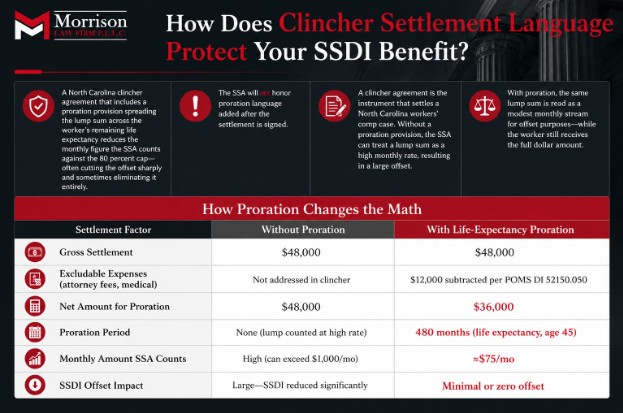
A North Carolina clincher agreement that includes a proration provision spreading the lump sum across the worker’s remaining life expectancy reduces the monthly figure the SSA counts against the 80 percent cap—often cutting the offset sharply and sometimes eliminating it entirely.
The SSA will not honor proration language added after the settlement is signed.
A clincher agreement is the instrument that settles a North Carolina workers’ comp case. Without a proration provision, the SSA can treat a lump sum as a high monthly rate, resulting in a large offset.
With proration, the same lump sum is read as a modest monthly stream for offset purposes—while the worker still receives the full dollar amount.
| Settlement Factor | Without Proration | With Life-Expectancy Proration |
| Gross Settlement | $48,000 | $48,000 |
| Excludable Expenses (attorney fees, medical) | Not addressed in clincher | $12,000 subtracted per POMS DI 52150.050 |
| Net Amount for Proration | $48,000 | $36,000 |
| Proration Period | None (lump counted at high rate) | 480 months (life expectancy, age 45) |
| Monthly Amount SSA Counts | High (can exceed $1,000/mo) | ≈$75/mo |
| SSDI Offset Impact | Large—SSDI has reduced significantly | Minimal or zero offset |
Attorney fees, medical costs, and certain litigation expenses are subtracted from the settlement before the SSA prorates it ( POMS DI 52150.050). A smaller base produces a smaller monthly figure and a smaller offset. The clincher must be drafted so these exclusions are clear and unambiguous.
Proration over life expectancy as a settlement-structuring method was approved in Sciarotta v. Bowen, 837 F.2d 135 (3d Cir. 1989), and is reflected in POMS DI 52150.060.
The SSA treats proration language added to an already-completed settlement as an attempt to circumvent the offset and rejects it. The protection must be built into the clincher when it is signed—which is why this decision must be made with counsel before settlement, not after.
The SSDI offset ends the month after workers’ comp benefits stop, or when the worker reaches full retirement age, and SSDI converts to retirement benefits—whichever comes first. For most workers born after 1959, full retirement age is 67.
For a worker on ongoing weekly comp benefits, the offset lifts when those benefits end—whether by reaching maximum medical improvement, exhausting the 500-week cap, or settling.
For a worker who settled by clincher with proration language, the prorated value continues to be counted for the period the proration covers.
And for any worker, reaching full retirement age removes the offset entirely because the SSDI-to-retirement conversion excludes the benefit from the offset rules.
Knowing which of these endpoints will arrive first—and planning around it—is part of structuring the claim.
A worker who is three years from full retirement age faces a very different calculation than a 45-year-old who will live under the offset for two decades.
That time horizon shapes whether a lump-sum settlement, continued weekly benefits, or a combination produces the highest net total across both programs. NC workers’ comp time limits and the 500-week statutory cap both factor into this planning.
Does a workers’ comp settlement reduce my Social Security disability in North Carolina?
A workers’ comp settlement can reduce SSDI because the SSA counts lump-sum settlements against the 80 percent cap. A clincher agreement with proration language that spreads the settlement over the worker’s life expectancy can sharply reduce or eliminate that effect. The language must appear in the original signed settlement.
Is North Carolina a reverse-offset state for workers’ comp and SSDI?
No. North Carolina is not one of the fifteen reverse-offset states. The SSA reduces the worker’s SSDI payment to stay under the 80 percent cap. The workers’ compensation benefit is never reduced. The reverse-offset list was frozen by federal law for plans in effect on or before February 18, 1981.
Will a lump-sum workers’ comp settlement lower my SSDI more than weekly checks?
A lump sum can lower SSDI more than weekly checks if the settlement lacks proration language. Without proration, the SSA may count the lump sum at a high monthly rate. With proration based on life expectancy, the monthly amount counted can be much smaller than the former weekly comp benefit.
Do I have to report my workers’ comp settlement to Social Security?
Yes. Federal law requires workers to report all workers’ compensation payments, including lump-sum settlements, to the SSA. Failing to report can trigger an overpayment notice, and the SSA can recover overpaid SSDI benefits by withholding a portion of future monthly checks.
At what age does the workers’ comp offset on SSDI stop?
The offset stops when the worker reaches full retirement age, and SSDI converts to retirement benefits, or when workers’ comp benefits end—whichever comes first. For workers born after 1959, full retirement age is 67. Once the SSDI-to-retirement conversion occurs, the offset rules no longer apply.
Can the workers’ comp offset on SSDI be eliminated completely?
Sometimes. Depending on the worker’s average current earnings, benefit amounts, and the settlement’s structure, proper proration and exclusion of attorney fees and medical expenses can reduce the monthly offset to zero. Whether elimination is achievable depends on the specific numbers in each case.
How long do I have to file a workers’ comp claim in North Carolina?
North Carolina law generally requires filing Form 18 with the NC Industrial Commission within two years of the injury date. For occupational diseases, the two-year window runs from the date a licensed medical provider first diagnoses the condition and connects it to the worker’s employment.
What is the maximum weekly workers’ comp benefit in North Carolina in 2026?
The NC Industrial Commission set the 2026 maximum weekly compensation rate at $1,446.00 for injuries occurring on or after January 1, 2026. The benefit equals two-thirds of the worker’s average weekly wage, subject to that cap. Even at the maximum, the benefit counts toward the SSDI offset.
What is a clincher agreement in North Carolina workers’ comp?
A clincher agreement is the legal instrument that finalizes a North Carolina workers’ compensation claim as a lump-sum settlement. Once signed and approved by the NC Industrial Commission, a clincher permanently closes the claim. The language inside the clincher—particularly proration provisions—controls how the SSA treats the settlement for offset purposes.
How does the SSA calculate average current earnings for the offset?
The SSA computes average current earnings using whichever of the three methods produces the highest figure: the average monthly wage underlying the disability benefit, the highest single calendar-year of covered earnings, or the highest five consecutive years. The agency sets the offset ceiling at 80 percent of the largest result.
Every dollar lost to a preventable SSDI offset is a dollar that cannot be recovered after settlement. Morrison Law Firm represents injured workers only—never employers or insurers—call 252-243-1003 today.

About the Author
B. Perry Morrison Jr. is a North Carolina attorney (Bar No. 16376) and founder of Morrison Law Firm, PLLC in Wilson, North Carolina. Since 1989, he has represented injured workers, Social Security Disability claimants, and personal injury victims throughout Eastern North Carolina, handling more than 3,000 workers' compensation claims before the North Carolina Industrial Commission. He concentrates his practice on workers' compensation, Social Security Disability, personal injury, and wrongful death cases, representing claimants exclusively rather than employers or insurance companies.
Mr. Morrison is admitted to practice before the North Carolina Supreme Court, all North Carolina state courts, the U.S. Fourth Circuit Court of Appeals, and the U.S. District Courts for the Eastern and Middle Districts of North Carolina. He has held leadership roles within the North Carolina Bar Association, including serving as Chair of the Litigation Section, and has earned the AV Preeminent® peer rating for legal ability and professional ethics. Through decades of advocacy, he has helped injured and disabled individuals navigate complex legal claims while protecting their rights and access to benefits.
Morrison Law Firm represents injured workers across Eastern North Carolina from its Wilson, NC, office. The firm accepts workers' compensation, Social Security Disability, and personal injury cases from Wilson, Nash, Edgecombe, Pitt, Martin, Wayne, Johnston, Greene, Halifax, Northampton, Warren, Wake, Harnett, Cumberland, Sampson, and Vance counties.

© 2026 Morrison Law Firm P.L.L.C
All Right Reserved
Practice Areas
Quick Links